
County: Statewide, All Counties | Incident: |
Resource Type: Immigration
Statewide Resources for Immigrants
211 is dedicated to serving all community members regardless of their immigration status, country of origin, political affiliation, or any other demographic characteristic.
Know Your Rights
Red Cards
All people in the United States, regardless of immigration status, have certain rights and protections under the U.S. Constitution.
Know Your Rights Red Cards are wallet-sized cards to help individuals understand their rights during encounters with immigration enforcement.
These cards include the list of rights in Spanish on the front of the card and English text on the back for ICE agents, making it clear that the individual is choosing to remain silent.
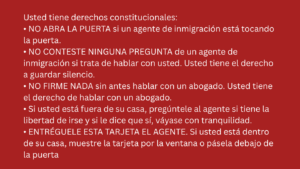
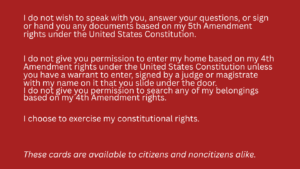
Click on the images above to be directed to the Immigrant Legal Resource Center (ILRC) website to print your Red Card at home. If you’re visiting this page from a mobile device, you can click on the images to save them on your phone.
Immigrant Legal Resource Center (ILRC) Immigration Preparedness Toolkit
The Immigrant Legal Resource Center (ILRC) offers a practical guide to help immigrants with no legal status or in mixed status families better understand their legal options.
The free ILRC Immigration Preparedness Toolkit includes tips on knowing your rights during ICE confrontations, planning for legal consultations, and accessing additional resources.
If You Are Detained
ACLU Immigrants’ Rights Page
Visit the ACLU Immigrants’ Rights page for information about rights in specific situations, including if you are detained near the border by Border Patrol or if you’re detained while your immigration case is underway.
ICE Online Detainee Locator
To search for someone who may be detained use the U.S. Immigration Customs and Enforcement Online Detainee Locator to locate a detainee who is currently in ICE custody or who has been in U.S. Customs and Border Protection’s custody for more than 48 hours.
Resources for Children and Families
Guidance for Immigration Issues Impacting Minors
The Immigrant Legal Resource Center Family Preparedness Plan has information about how to make a plan that includes how to plan for who can care for your children if you are unable to and what information and documents you should have ready for your children. The Plan also includes information about getting legal advice and the Know Your Rights Red Card information in the section above.
The California Courts Self-Help Guide has information about the different types of forms you can use to ensure whoever would care for your children is able to handle school and medical issues.
Unaccompanied Children Who Have No Lawful Immigration Status
The Administration for Children & Families’ Office of Refugee Resettlement (ORR) is responsible for children who do not have lawful immigration status and do not have a parent or legal guardian in the United States. These children may be referred to as “unaccompanied alien children”. The ORR’s Unaccompanied Alien Children (UAC) Bureau takes unaccompanied alien children in the least restrictive setting that is in the best interest of the child.
To find a child in the care of the Office of Refugee Resettlement, contact the ORR Parent Hotline by calling, texting, or emailing:
Call 1-800-203-7001, text NINOS to 66467 (24/7), or email: information@ORRNCC.com
Consulate Locator
Find your nearest consulate or embassy using the Department of State Directory of Consulates and Embassies
Services from the Mexican Consulate
Visit your nearest Mexican Consulate if you need assistance with personal documents, travel documents, or to learn more about the México Te Abraza program.
Centro de Información y Asistencia a Personas Mexicanas (CIAM)
The Center for Information and Assistance for Mexicans (CIAM) is a call center that can help with consular services, assistance locating family and friends, including locating a detained family member, advice on legal and immigration matters, and counseling if you have been the victim of abuse or fraud. CIAM is available 24 hours a day, 7 days a week: (520)-623-7874
México Te Abraza
México Te Abraza is a program by the Mexican government to support individuals who are returning voluntarily or have been returned to Mexico. It assists with the repatriation process and helps people reintegrate with the support of the Mexican government. The program includes ten Welcome Centers along Mexico’s border, offering assistance to those who have been deported or are returning voluntarily.
México Te Abraza provides the following supports:
- Assistance with repatriation process
- Prepaid card with 2000 pesos
- Free transportation to city of origin
- Help finding a job
- Help with senior pensions for older adults
Watch President Sheinbaum share her message on the goals of the México Te Abraza program.
Learn more about México Te Abraza: Gobierno de México.
Resources For Employers
A Guide for Employers: What to Do if Immigration Comes to Your Workplace, practical advice for addressing immigration-related actions in the workplace (National Immigration Law Center).
Blue Card, a quick guide for staff members who may interact with ICE (Inner City Law Center).
Safety Planning and Guidance for Social Service Organizations (Alliance for Immigrant Survivors)
Warrants and Subpoenas: What to Look Out for and How to Respond, a factsheet clarifying immigration enforcement and subpoena powers and what do to in response to receiving an immigration warrant or subpoena (National Immigration Law Center).
Sample ICE warrants (Immigration Legal Resource Center)
Local Resources for Immigrants
For local resources, click on your county below:
Ventura County | Inyo County | Lake County
Marin County | Monterey County | Napa County
San Benito County | San Francisco County | San Joaquin County
San Luis Obispo County | San Mateo County | Santa Barbara County
Santa Clara County | Solano County | Sonoma County
Other Resources
Call 211 or search for resources online if your household has been impacted by immigration detainment or deportation and you need additional help with things like:
- Clothing and personal items
- Childcare
- School enrollment assistance and educational advocacy
- Mental health counseling
- Utility Payment Assistance
- Food assistance
- Housing support or emergency shelter
- Healthcare